


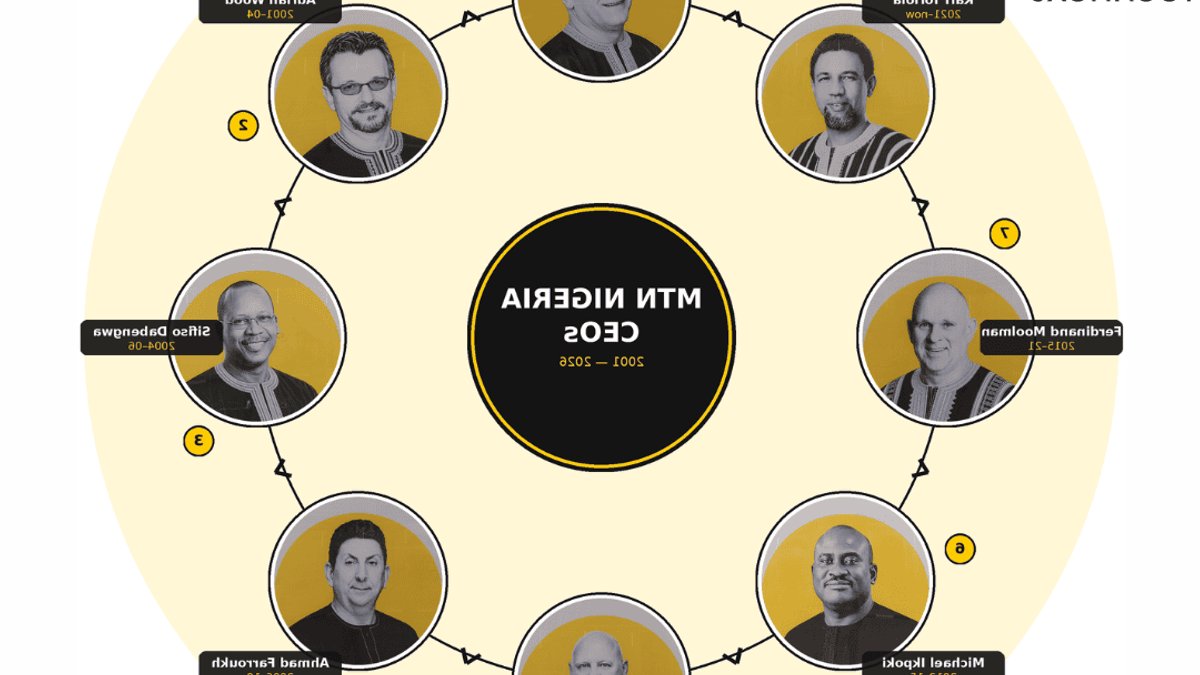
MTN Nigeria has marked its 25th anniversary, a milestone that highlights the strategic leadership of its Chief Executive Officers. Over the past quarter-century, the reins of the company have passed through eight distinct leaders, each bringing different innovations to solve the specific challenges of their era. From the visionary pioneers who laid physical fibre to the strategists who handled regulatory storms, these executives drove significant marks along the journey.
The company began with Sifiso Dabengwa, who took over in 2004 after Adrian Wood. Wood, the pioneer who acquired the historic digital mobile license for $285 million in 2001, helped transition the country out of an era where landlines cost thousands of dollars. He established the initial benchmarks for network quality and distribution channels. Dabengwa built on this foundation by standardising network quality and perfecting the per-second billing system, which democratised mobile communication by making airtime affordable for Nigerians.
Related: Airtel Africa CEO pushes for infrastructure sharing
Dabengwa helped scale the company’s infrastructure and grew subscriber numbers dramatically. The performance propelled him to become Chief Operating Officer at MTN Group and later Group President and CEO in 2021. Despite stepping down in November 2015 due to the historic $5.2 billion fine, he is remembered as a telecom titan. His key legacy includes cementing the per-second minute system and ensuring access to affordable airtime via recharge cards.
Ahmed graduated from the group’s management trainee programme in 2008. During his tenure, he guided the company through a period of massive subscriber expansion and cemented its market dominance. He grew the subscriber base from roughly 9 million to over 40 million users, championed rural telephony, and expanded network coverage during a key growth phase. Farroukh laid the foundation for corporate social investment via the MTN Nigeria Foundation. His key legacy is remembered for the subscriber growth and kick-starting programmes that made the company walk along Nigerian culture.
Brett joined Nigeria after his tenure as the MTN Ghana CEO. He arrived at a time when broadband connection was taking shape in Africa, largely fueled by the gradual adoption of smartphones. He managed massive subsea cable integration, such as the West Africa Cable System (WACS), which led to lower broadband costs. This period set off Nigeria’s modern smartphone and internet revolution. After his tenure, he joined MTN Group as the Chief Financial Officer.
Related: Economic Sustainability in Indonesia’s Pharmacy Sector
Michael made history as the first indigenous Nigerian CEO of the company since its entry in 2001. His appointment in July 2013 symbolised deep confidence in homegrown Nigerian corporate talent. He pushed corporate digital services and positioned MTN as a partner for enterprise business. He worked closely to improve dialogue between the telecom sector, local communities, and regulatory bodies like the Nigerian Communications Commission (NCC). Michael resigned in December 2015 in the wake of the historic ₦1.04 trillion ($5.2 billion) regulatory fine imposed by the NCC over unregistered SIM cards. His key legacy is guiding the company as it managed surging demands for mobile data services alongside existing infrastructural bottlenecks.
Ferdinand Moolman (2015 – 2021) took over at a critical point. He guided the company through complex resolution talks and severe government fines. His significant achievement was converting MTN Nigeria into a transparent, publicly listed Nigerian company. The operator listed on the Premium Board of the Nigerian Stock Exchange on May 16, 2019, via an introductory listing at an initial price of ₦90 per share. Two years later, the company executed a landmark retail public offer for 575 million shares in December 2021 at ₦169 per share, successfully oversubscribing by 139.47%. Ferdinand stabilised investor relations and grew the subscriber base past 67 million. His key legacy is MTN Nigeria’s launch on NGX that broadened local investors’ recognition.
Related: How Tampa-Based Advertising Companies Are Helping Local Businesses Grow
Karl Toriola took over as MTN Nigeria CEO on March 1, 2021. He expanded the 4G coverage and championed the 5G rollout, Nigeria’s first. He managed massive macroeconomic headwinds, currency devaluations, and inflation impacts while maintaining MTN as Nigeria’s largest mobile operator. He secured a highly coveted banking license for MoMo PSB, shifted MTN Nigeria from a traditional telecom firm into a modern TechCo and drove active subscribers past 92 million.
In recognition of his performance in Nigeria, he was appointed as Vice President of Francophone Africa in late 2025, adding regional oversight of countries like Cameroon, Côte d’Ivoire, Benin, and Congo-Brazzaville while retaining his core Nigerian CEO duties. His key legacy is leading the 5G era, withstanding tough financial moments and driving subscribers past 90 million. The shift toward fintech and digital services under his leadership represents a structural change that could define the next phase of the company’s operations.
